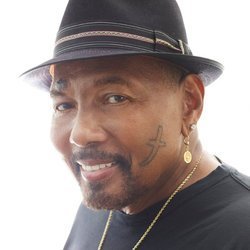

Art Neville
If you’re lucky enough to be born in New Orleans, you’ve automatically inherited a lush tapestry of traditions, of which the richest, most varicolored and enduring motif is music. Arthur Neville came into that inheritance in 1937, but in his case the real luck fell to New Orleans, where he has spent most of a lifetime enhancing and expanding that tapestry. It’s open to debate exactly where Art learned to weave such glorious new colors into such an already-vibrant fabric of sound – parents who supported and encouraged his musical quest? A childhood curiosity about music in general, and the keyboard in particular? Simply the intense and heady musical environment of the city itself?
What can’t be argued that even as a kid he had already begun to shape the sumptuous patterns that the world now recognizes instantly as the Nevilles Sound. As a teenager, no amount of music – even in New Orleans – was too much for Art. He worked for a time in a record shop, where he absorbed the great doo-wop groups of the day: Clyde McPhatter’s Drifters, The Orioles, The Clovers, as well as local piano rockers Professor Longhair and Fats Domino. In time he formed his own doo-wop group, and after school, after work, they would sit on a park bench in the crazy half-moon city and sing to the night.
In 1953, Art joined the Hawkettes, who recorded the classic “Mardi Gras Mambo” in 1954. That song turned out to be more influential to other musicians – and to the City of New Orleans – than even Art could have imagined. Listen to the music of his reflections on that historic (and now, very traditional) piece of pop culture:
“I became involved with the Hawkettes, I don’t even remember the exact year but it must have been in ’53. A friend of mine, one of the members of the Hawkettes at the time, George Davis. He was taking saxophone lessons from Alcee Wallace, one of my friends that we had the doo-wop group with. Mr. Wallace, Alcee’s father, was teaching George Davis saxophone and so he told him about me and he needed a piano player.” “And so he came to my home and asked me would I be interested in playing with the Hawkettes. I didn’t know who they were at that point and I said “sure,” and my mother and father said ‘Yeah, go ahead.’ And the rest is really history. We went on, and we were the hottest band in New Orleans and the surrounding area we played for every function like sororities, fraternities, and different other functions around New Orleans: Night clubs, little small clubs, large clubs.”
“We recorded this song, ‘Mardi Gras Mambo,’ I don’t even remember the year, I think 1953 or 1954, something like that, and lo and behold! ‘Mardi Gras Mambo’ is still here today.”
Most of the Hawkettes went off to college and other pursuits after the recording was made, but Art kept the Hawkettes together, finding musicians where he could. And did. The Hawkettes got such a wide reputation that by 1957 they found themselves touring with Larry Williams, whose “Short Fat Fannie” and “Bony Maronie” had also gone into the pop canon, and remain there. Art came home from this tour (which included the Spaniels), to be drafted into the Navy Reserve’s active duty for two years. “N.A.S., Oceana, Virginia Beach. Aviation,” he remembers. “It was a good experience.” In a recent discussion, Art remarked, “I was in the Navy Reserve – and I wasn’t making the meetings that I should have been making – I was playing Rock ‘n Roll.. So they drafted me on Active Duty and that must have been ’59 or ’60.”
Brother Aaron hung in there with the Hawkettes, and when Art returned he rejoined his old friends. “Meanwhile, we started changing players, and we ended up with the guys who wound up being the Meters: Zigaboo, Leo, George,” he says.
At the same time, Allen Toussaint and Joe Banashak approached Art with a song that’s long since been a New Orleans staple: “All These Things.” Art jumped at the chance to record it. “I can see it now,” he says fondly.
By 1966, he was touring with brother Aaron in support of the hit single, “Tell It Like It Is.” Another classic. Soon after the tour, Art took the first shot at a Neville Brothers grouping with “Art Neville and the Neville Sounds.” The band consisted of Leo Nocentelli on guitar, George Porter on bass, Art on piano and organ, Zig Modeliste on drums, brothers Cyril and Aaron Neville and, on saxophone, Gary Brown. It was strictly a labor of love, and the band wasn’t making money. But they were getting tighter, more streamlined musically, the sound was getting around. Eventually Art was offered a chance to play the Ivanhoe bar in New Orleans’ French Quarter – a coveted gig among local musicians, except that the venue could only accomodate four musicians onstage. Cyril, Aaron and Gary Brown bowed out and went on to pursue their own musical paths, but what remained was a white-hot quartet with a solid rhythmic vision. There at the Ivanhoe, the Meters were born. The band developed a funk-infected R-B sound characterized by subtle shadings and the loose interplay among guitar, bass and Art’s Professor Longhair-inspired keyboard figures. Producer/writer Allen Toussaint took one listen and wanted the Meters for session work.
With Toussaint at the boards, the band released The Meters (1969), featuring the signature instrumentals “Cissy Strut” and “Sophisticated Cissy.” By 1972, big fish were circling and the Meters recorded their first of several albums for Warner Brothers. On the strength of this work, the Meters opened for the Rolling Stones’ “Tour of the Americas” the following year. In 1976, the Neville brothers’ revered uncle George Landry called the boys together to work on an album entitled “The Wild Tchoupitoulas,” an aural documentary of sorts of the Mardi Gras Indians. Landry told Art then that the Neville’s parents had always longed to see the four brothers work together, and in 1977 that dream became reality for everyone. With Art on keys, Charles blowing sax, Cyril slapping congas and Aaron, well, playing Aaron on vocals, the Neville Brothers groove at last wove itself indelibly into the tapestry. The Neville Brothers was released on Capitol, but so unique and unclassifiable was the sound that the corporate thinkers didn’t quite get how to market it.
Not black or white, not strictly soul or R-B, not exactly pop but not rigidly rock either, the problem wasn’t so much that the Neville Sound was neither here nor there as that it was here, there and everywhere imaginable. It was off the label’s graph and therefore out of its grasp. Things got better. Radio, the national and then the international audience began to blossom with A-M’s Fiyo on the Bayou and later Neville-ization. By the time of Uptown Art and the boys were sending their New Orleans sound around the world and back again, and they followed with more of the family groove in albums like the nearly flawless Yellow Moon. The basics stitched together by Art and his keys have created ripples of soulful patterns across every curve in the musical sphere, influencing artists as diverse as Santana, and the Rolling Stones. And Art weaves on. Maybe only the lucky get to be born in New Orleans. But Arthur Neville’s vision has made it possible for the rest of us to share a little bit of the grand fortune he’s given back to his city.