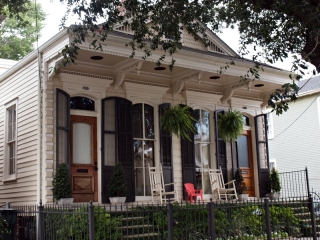
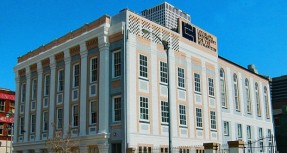
Things to look out for include beads in trees, mansions, Commander’s Palace, Lilette, Mahoney’s, Lafayette Cemetery No. 1, St Charles Avenue, the streetcar, Anne Rice’s old pad and during carnival season, good parades.
St Patrick’s Day in New Orleans
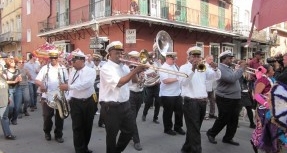
No sooner have New Orleanians put their Mardi Gras costumes into a cardboard box marked ‘Carnival Time’ that is dusted with lipstick, beads and beer stains, we bust out our beer coosies and go-cups for March 17. Does New Orleans know how to do Paddy’s Day? Folks, were a city built on music, food, drinking and celebration. Also, we throw cabbages at yo’ head (more on this later). Boston, eat yah haht awt.
(We do know, by the way, that in its original incarnation St Patricks Day is a saint day holy to the Catholic calendar, marked in much of Ireland with quiet prayer and thoughtful reflection. But world knows Paddy’s Day as a day of copious drinking, green beer and bad headaches on Mar 18, and that’s our frame of reference for comparison).
Anyways, New Orleans kicks of St Patrick’s day right. Traditionally, ne of the largest parades is at Molly’s in the Market; at the last one we went to, the grand marshal was Edwin Edwards, the four-term Louisiana governor who was indicted and imprisoned on corruption charges in 2002. The queen of the parade was the then-84 year old Edwards’ 33-year old wife, who he courted through the prison pen pal service. Did we mention we love this state?). An enormous bloc party also goes down at Parasol’s, but for our money you can’t beat the Irish Channel Parade, which runs through the Lower Garden District and features one of the city’s best throws: cabbages on beads. They will knock our ass out if they hit you in the head (well, the Guinness and Jameson don’t help in this regard), so keep your eyes on the prize.
Live Oaks
Quercus virginiana, the Southern Live Oak, may be the state tree of Georgia, but it is the iconic tree of New Orleans, particularly the Garden District, Uptown, City Park and Audubon. The huge trees line city streets, particularly Carrolton and St Charles Avenue, where they form a veritable tunnel of shade and fresh air. The live oaks that line St Charles Avenue date back to the early 20th century.
Live oaks can reach heights of 65’-85’. They seem to grow out, rather than up; the trees are characterized by wide crowns with tough leaves (and in New Orleans, beads; because any parade routes go down St Charles Avenue, the beads they toss to the crowd typically end up in oak branches).
As you walk under the city’s live oaks, be lookout for the small –inch long acorns and clumps of reddish-brown bark, both of which fall off of the trees.
St Charles Avenue
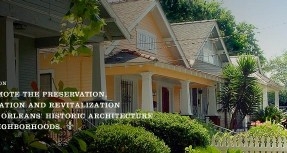
We don’t have an issue calling St Charles Avenue the most beautiful street in America. There is now greater concentration of mansions in the country, each one a testament to an architectural school and tradition in terms of age, design, concept and execution. The addition of hundreds of live oak trees providing shade and fresh air, plus the cranking romantic nostalgia of the St Charles Streetcar, only add to the loveliness.
Although this grand avenue technically extends from Canal St to Carrollton, forming a wide smile on the bottom of the city in the process, we would say the best parts of the St Charles begin in the Lower Garden District, around Jackson Ave. There are plenty of ways of exploring the street, but we highly recommend jogging (o n the neutral ground), biking or using the streetcar. There are too many historical buildings to list here, but some of note include Touro Synagogue, near the intersection of General Pershing St; the Latter Memorial Library, which occupies an Italianate mansion; the Brown Mansion, at Valence St, a Romanesque structure that is the largest mansion on the avenue; the Anthemion house, on the opposite corner of Valence, which once served as the Japanese consulate, and the Columns Hotel, at Peniston St, which houses one of the better bars in the city.
Roast Beef Wars: the Parasol’s-Tracey’s feud
On the corner of Third and Constance street, you’ll find Parasol’s, a lean-to shack of a dive bar that serves up good whiskey, clouds of cigarette smoke and melt in your mouth roast beef. Just up the road, on the corner of Third and Magazine, is Tracey’s, a flash sports bar and also trades in roast beef goodness.
These two businesses have a bit of history. Parasol’s was operated for 12 years by one Jeff Carreras, but when the business was sold to John and Thea Hogan, Carreras upped sticks and opened Tracey’s. Po-boy traditionalists were torn in a civil war that wrenched the city, causing blood feuds of brother against brother not seen since the War Between the States (we may be hyperbolizing).
Who does the better sandwich…you know what? We’re not gonna get into this, because someone will have our heads. Let’s say this: Tracey’s is the better spot to watch a game if you want big screen TVs. Parasol’s serves up a better Channel Rat vibe of smoke, spirits and the right amount of New Orleans grime. Take your pick.