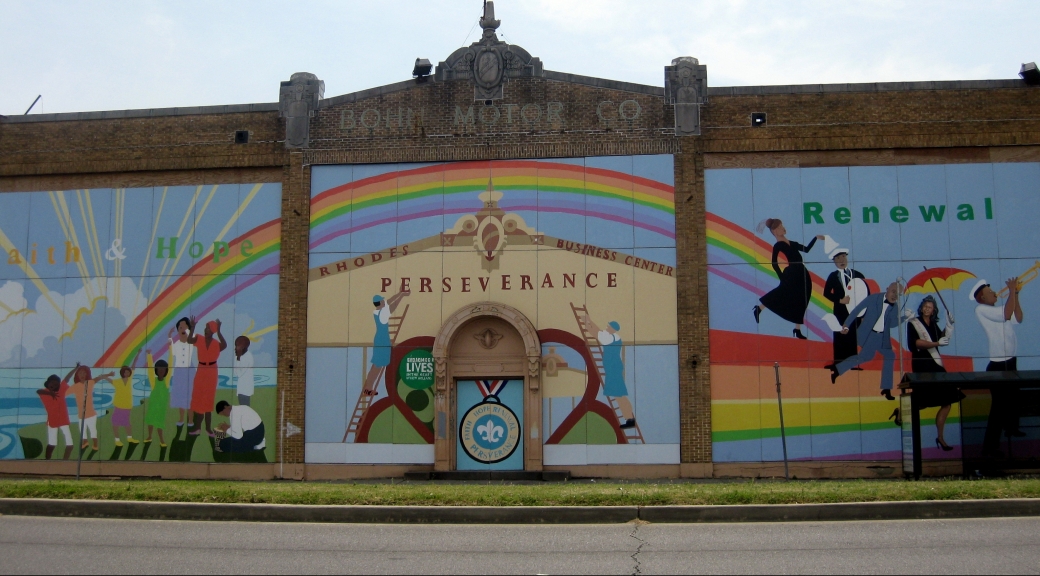
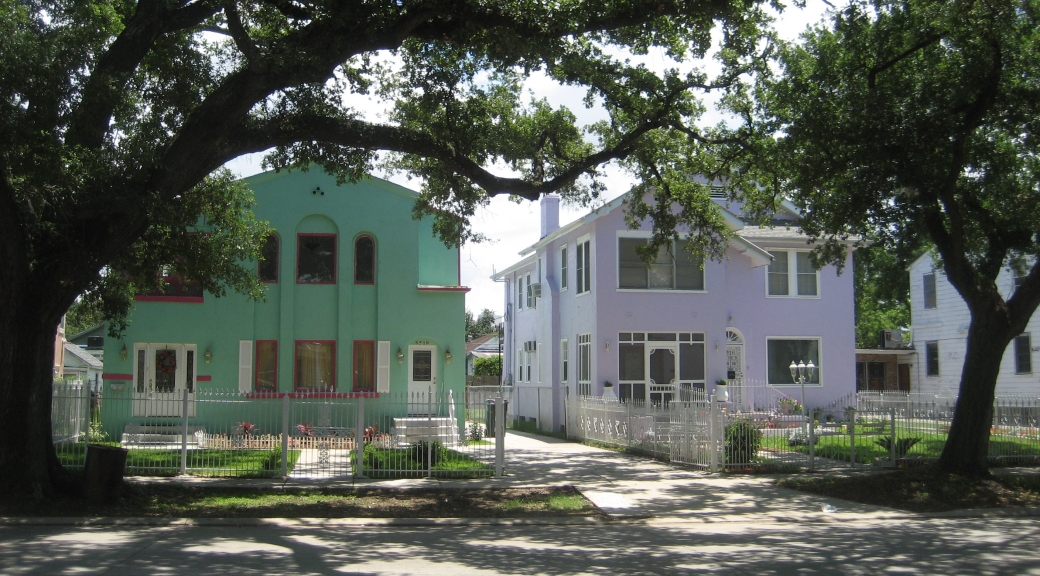
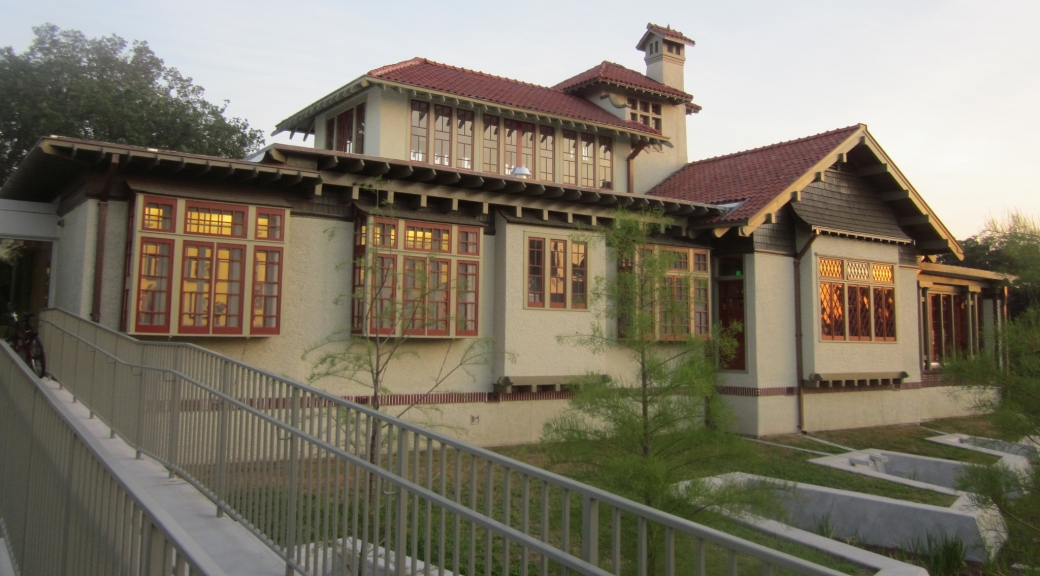
In New Orleans’ early days, the land where Broadmoor lies was a marshy pasture that during heavy rains became a 12-acre lake, connected to Bayou St. John by a stream, where uptown New Orleans residents enjoyed fishing.
The area was marked “Vacant Land†on Charles Zimpel’s 1834 Topographical Map of New Orleans, and it was 139 years after the founding of New Orleans when plans were drawn up to drain the area in 1857.

The first drainage canal in the area was dug under present-day Claiborne Avenue in 1871, but by 1873, there was only one landowner, listed as Barthelemy, in the Broadmoor area.
Drainage canals were dug in the 1880s, however, and Pumping Station #1 at South Broad and Melpomene streets was completed in 1902. Drainage remains an issue, with millions of dollars in federal SELA projects under way in the vicinity.
The largest percentage of construction in Broadmoor occurred between 1920 and 1924. The earliest homes in Broadmoor were raised with full-story above-ground basements and living quarters on the second floor. The Andrew H. Wilson School at 3617 Gen. Pershing St. opened in 1922, and the Broadmoor Civic Improvement Association was formed in 1930. Streetcar lines along South Claiborne Avenue and Napoleon Avenue linked Broadmoor residents to the central city.
The opening of the Chevra Thilim Synagogue on the corner of South Claiborne Avenue and Jena Street in 1948 attracted a large Jewish population to the area. The Orthodox Chevra Thilim congregation, with ties to Eastern Europe, had built a small synagogue at 826 Lafayette Street in 1915. The prosperity of its members allowed many to move from the central city and finance construction of the new building. Throughout the 1950s and ‘60s, more than 30 percent of the students at the Wilson School were Jewish. In addition, the Communal Hebrew School, across the street from Wilson, educated thousands of Jewish children during these years.
I
The Chevra Thilim congregation was one of several to experiment with mixed seating for men and women in the 1950s. The board of directors’ decision to allow this in 1955 led to a lawsuit, Katz. vs. Singerman, the proceedings of which were carefully followed by many Orthodox Jews from across the country.
The Louisiana Supreme Court ultimately found that mixed seating did not violate the congregation’s charter to worship in “the Orthodox Polish Jewish tradition.†Following the decision, the congregation split, with advocates of mixed seating ultimately founding New Orleans’ first Conservative congregation, Tikvat Shalom. The two congregations reunited in 1999 and formed Shir Chadash, meaning “A New Song,†which has its synagogue in Metairie.
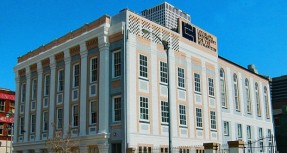
The Chevra Thilim synagogue is now occupied by a Baptist congregation that offers many programs and services to the neighborhood.

The federal levee faillure associated with Hurricane Katrina left Broadmoor flooded with up to 8 feet of water. In January 2006, the Bring New Orleans Back Commission recommended that Broadmoor, as a low-lying area of the city, be designated as a “green dot†on the redevelopment map, best-suited for a drainage park.
Residents rallied in opposition to this notion, with notable success. The Broadmoor Improvement Association’s work became a model for citizen-led recovery efforts. The association set up shop in a doublewide trailer at the Church of the Annunciation and began reaching out to scattered residents, urging them to return.
II
Association volunteers surveyed the neighborhood and created their own redevelopment plan for it, raising money through private and public partnerships, including a major commitment from the Clinton Global Initiative. In March 2006, Harvard students began assisting with developing, documenting and implementing the recovery plan. In the summer of 2006, the Broadmoor Improvement Association reached out to Bard College in New York and Plan Ready, a technology and mapping firm in California, to help design and carry out a comprehensive, building-by-building survey of the neighborhood and create a mapping system to manage the information gathered.
In the three years following Hurricane Katrina, a remarkable 79 percent of Broadmoor’s flooded properties were restored. The Wilson School reopened in 2010 after a $29 million renovation including LEED certification. The Keller Library reopened in March 2012, with a substantial boost from a $2 million grant from the Carnegie Corporation of New York that was announced in June 2007.
In 2010, voters approved creation of the Broadmoor Neighborhood Improvement District, with the power to levy an annual $100 fee for five years on all neighborhood property for “quality-of- life initiatives and encouraging the beautification and overall benefit†of the area.
Modern-day drainage work in and near Broadmoor takes the form of two Southeast Louisiana drainage projects authorized by Congress in 1996 and administered by the Sewerage and Water Board of New Orleans and the U.S. Army Corps of Engineers. The first phase of the Napoleon Avenue Canal project, widening the existing concrete box canal between South Broad Street and Claiborne Avenue, was completed in 2003. The second phase, from South Claiborne to Carondelet Street, is scheduled for completion in March 2015. No start date has been determined for the third phase, from Carondelet to Constance streets.
Phase 1 of the South Claiborne Avenue Canal project, from Monticello Avenue to Leonidas Street, is scheduled for completion in July 2014. Phase 2 of the Claiborne Avenue project, from Leonidas to Lowerline, is scheduled for completion in April 2016.

III